


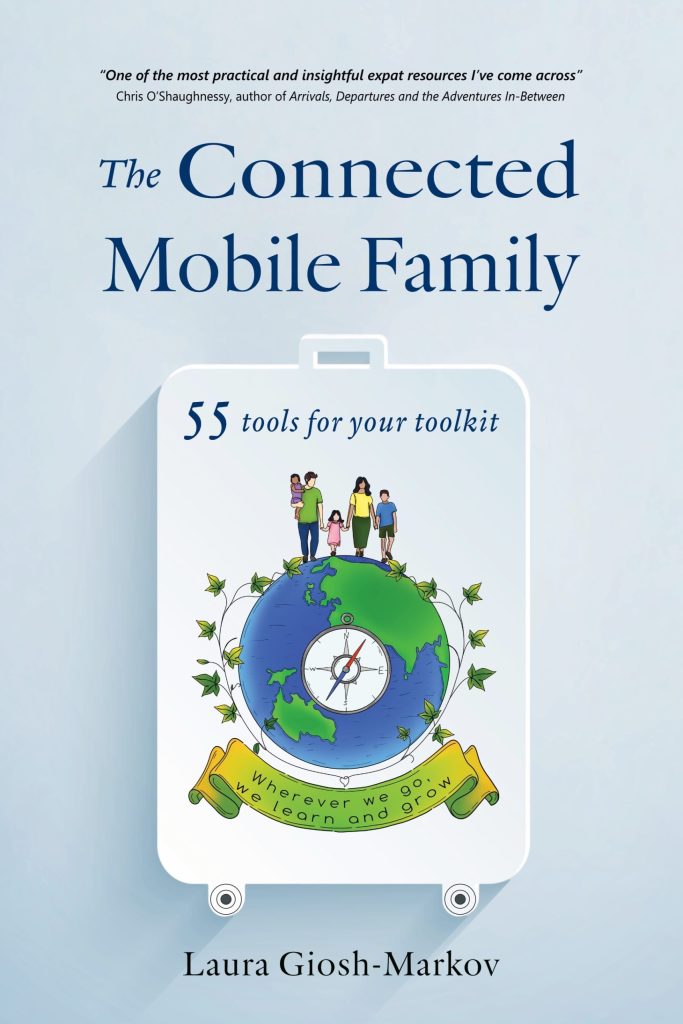
In a recent newsletter of Christopher O’Shaughnessy, a book he mentioned caught my interest: The Connected Mobile Family, by Laura Giosh-Markov. I contacted Laura to write an article about it and discovered she has an amazing story. Here is our conversation about her book and much more.
Laura, you are presently living in Bulgaria. Could you tell us a bit about the decision to move there, and how is life in your host country?
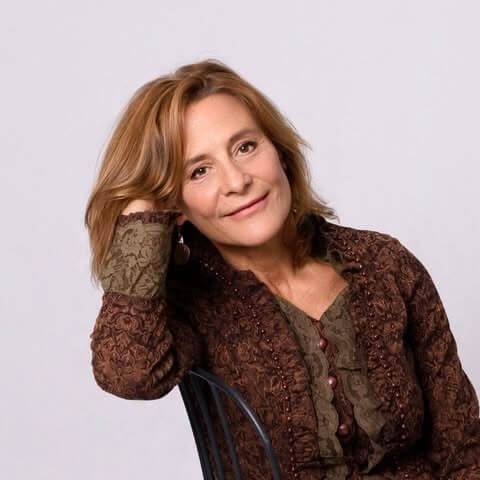
In the late 80’s, I was living in France and performing in Paris CATS. I met my husband in an elevator going up to a mutual friend’s place. He was a guitarist from Bulgaria with a band that had been touring in the USSR, Scandinavia and Western Europe. He moved to Paris to work in a recording studio. After kicking around Paris together for a few weeks, we bonded.
A few months later, I boarded a train to Sofia. Arriving at the dirty, drab Sofia train station, I questioned my decision. After all, I hardly knew this guy and I knew nothing about Bulgaria. But there was my Konstantin – a bright spot in the shadowy world, holding a bouquet of flowers to welcome me. In the first few months, I came to realize he was the well-known and well-loved leader of one of the most popular rock bands – Tangra. He later got the band together again and they toured during the early years of the 2000’s. Their songs and popularity still carry on, even after his death in 2021.
Those first years of 1990’s post-communism were ones of shortages- fuel, water, electricity. food, daily supplies. No cultural life, no banks, no phone system. I began teaching music, French and theater in the French and American schools, and later was the Transition Counselor and Parent Consultant. Kosio and I rode the wave into the new Bulgaria through our work, music, and the cultural scene.
Over the next three decades, we experienced the rebuilding of a country, society, and economy first-hand. Once Bulgaria joined the EU, it improved its infrastructure and maintained a stable economy. Now, it’s easy to travel around the country, and Sofia has a great public transportation system. There are even some bike lanes throughout Sofia, which I use regularly! Theatres and concert halls abound and are always full. There is a choice of shops and restaurants, touristic sites to visit, and abundant yoga and dance studios and gyms for fitness.
I feel blessed to have been present during the rebuilding of the country, especially supporting Kosio in his work. I continue to enjoy the many opportunities for culture, nature and connecting with others here. Presently, I am co-director at a private kindergarten. I train teachers and lead parent workshops for social-emotional tools, along with connecting with the little ones to inspire their English in fun ways.
This is all so interesting, and congratulations for all the things you managed to do professionally! You mention you became the Transition Counselor and Parent Consultant at the American School, is this role that motivated you to write The Connected Mobile Family”?
The Anglo-American School in Sofia hosts more than 45 different nationalities. When I arrived there in the 90s, there was no regular counselor and no transition program. I was teaching French and Music but invited parents in for transition meetings with a colleague. Very few materials were easily available for expats but as I learned more about the difficulties students and parents faced, I was motivated to get my master’s degree in school counseling. I must admit that while I was helping others, it was a form of self-help with witnesses: How to create stability and at the same time, make sense of the myriad of multicultural experiences?
During that period, I also had a lot to learn as a new parent, which is when I started poring through parenting books. I diligently used the tools as survival tactics! Fortunately, my students benefited from the ‘new improved’ me. I started sharing this Adlerian approach with parents who were also eager to get practical strategies to have better relationships with their kids.
So, yes, my book, The Connected Mobile Family, includes transition tools and parent tools that I have shared for more than 20 years. With a bigger audience now, I am pleased to see that parents are using these strategies to make their mobile and parenting journeys more enjoyable.
Tell us a bit more about it: how did you go from the decision to the publishing phase? And also: who should read your book, apart from the parents you have already mentioned?
The decision to write the book came from a talk with children’s author, Julia Cook. She recommended I create a toolkit for counselors detailing the activities I used with international families and parents. After I wrote out the tools, Jo Parfitt encouraged me to move ahead with publishing it. I shared the idea of the book with other expats who were eager to get a copy and start using it. This certainly lit a fire under me to hurry up the process!
Teachers, counselors, or anyone else who works with TCKs, CCKs or Digital Nomads can find useful ideas to support students and clients. My hope is that the tools spark ideas and variations that can be adapted to the needs of their specific situations.
Digital nomads can benefit from the first part of “The Connected Mobile Family” which briefly introduces information and challenges of a mobile lifestyle. It lays the groundwork for why the tools create connection and stability to lessen the long-term effects of mobility: Tools to strengthen one’s sense of self, create meaning in one’s personal journey, and get the most out of the different experiences.
I have used all of the tools in my counseling practice with both mobile and non-mobile clients – adults, children, and teens. I am sure anyone seeking to expand their skill base can find something practical in my book, as participants in the workshops I’ve offered, have confirmed.